Chiura Obata "Evening Glow of Yosemite Fall" Postcard
As a young artist in Tokyo, Chiura Obata studied Japanese sumi ink-and-brush painting, a technique he continued to use throughout his life. After moving to San Francisco in 1903, Obata founded the East West Art Society and in 1932 became a professor at the University of California, Berkeley. In the summer of 1927 Obata had traveled from San Francisco to Yosemite and the High Sierra, a trip he described as “the greatest harvest for my whole life and future in painting.” Over the course of six weeks of hiking and camping, Obata produced roughly one hundred landscapes in pencil, watercolor, and sumi ink, inspired by the striking natural beauty of the wilderness.
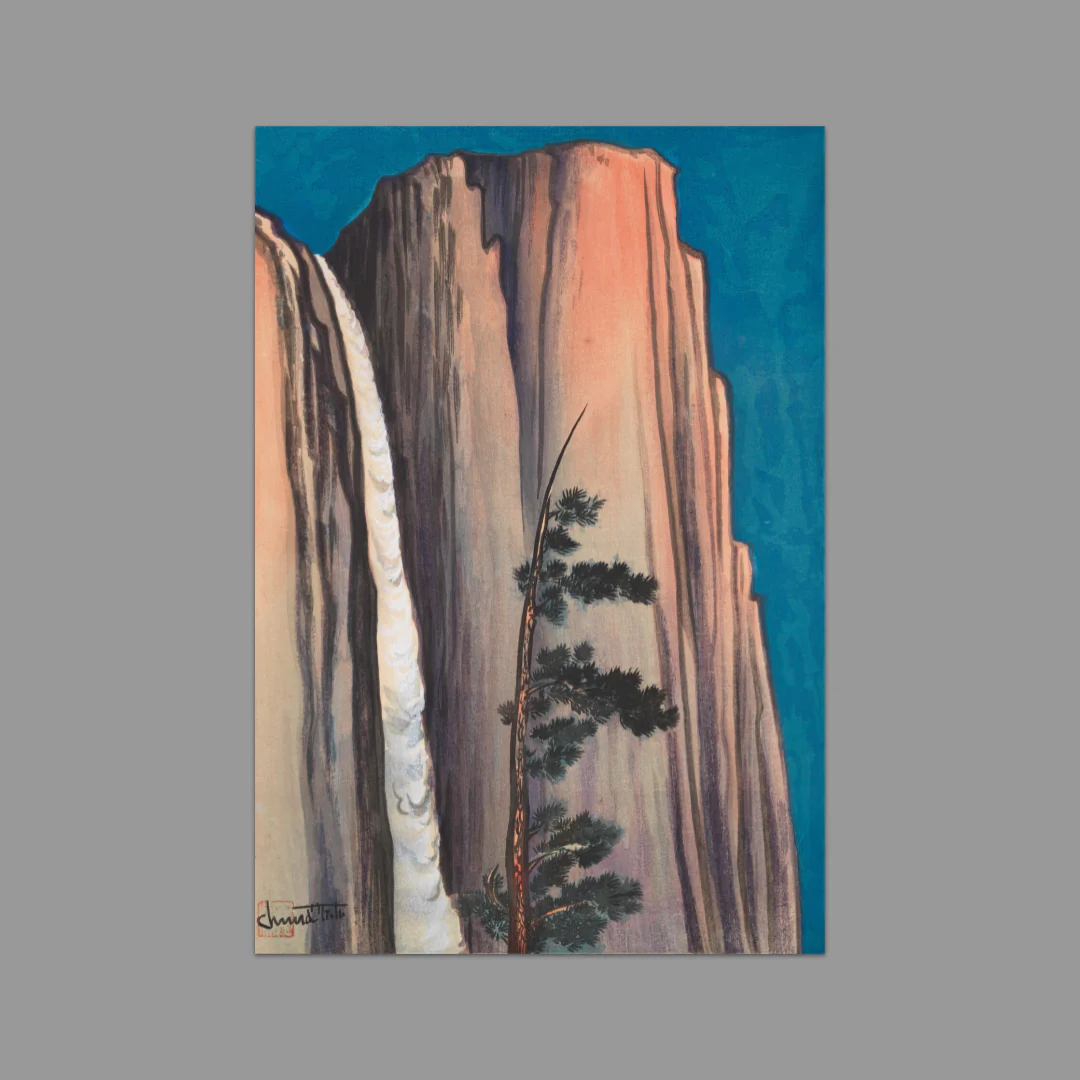
Evening Glow of Yosemite Fall (1930) is from the World Landscape Series “America”, a portfolio of thirty-five woodblock prints, most made after his watercolors from Yosemite. Obata made the prints in Japan at the Takamizawa Print Works over the course of an eighteen-month period beginning in 1928. He worked with thirty- two wood carvers and eighteen printers, and each image required between 120 and 205 progressive proofs, resulting in an astonishing level of detail in which the hairs from individual brushstrokes are faithfully captured. Each print represents the deep impact the distinctly American landscape had on Obata, as filtered through his unique synthesis of Eastern and Western traditions and techniques. Steeped in the Zen tradition, Obata often spoke of the sublime qualities of the natural world and wrote of Yosemite Falls, “This waterfall makes the music of heaven; it is music more inspiring than man-made music.”
Evening Glow of Yosemite Fall (1930) is from the World Landscape Series “America”, a portfolio of thirty-five woodblock prints, most made after his watercolors from Yosemite. Obata made the prints in Japan at the Takamizawa Print Works over the course of an eighteen-month period beginning in 1928. He worked with thirty- two wood carvers and eighteen printers, and each image required between 120 and 205 progressive proofs, resulting in an astonishing level of detail in which the hairs from individual brushstrokes are faithfully captured. Each print represents the deep impact the distinctly American landscape had on Obata, as filtered through his unique synthesis of Eastern and Western traditions and techniques. Steeped in the Zen tradition, Obata often spoke of the sublime qualities of the natural world and wrote of Yosemite Falls, “This waterfall makes the music of heaven; it is music more inspiring than man-made music.”
$1.05
Original: $3.00
-65%Chiura Obata "Evening Glow of Yosemite Fall" Postcard—
$3.00
$1.05Chiura Obata "Evening Glow of Yosemite Fall" Postcard
As a young artist in Tokyo, Chiura Obata studied Japanese sumi ink-and-brush painting, a technique he continued to use throughout his life. After moving to San Francisco in 1903, Obata founded the East West Art Society and in 1932 became a professor at the University of California, Berkeley. In the summer of 1927 Obata had traveled from San Francisco to Yosemite and the High Sierra, a trip he described as “the greatest harvest for my whole life and future in painting.” Over the course of six weeks of hiking and camping, Obata produced roughly one hundred landscapes in pencil, watercolor, and sumi ink, inspired by the striking natural beauty of the wilderness.
Evening Glow of Yosemite Fall (1930) is from the World Landscape Series “America”, a portfolio of thirty-five woodblock prints, most made after his watercolors from Yosemite. Obata made the prints in Japan at the Takamizawa Print Works over the course of an eighteen-month period beginning in 1928. He worked with thirty- two wood carvers and eighteen printers, and each image required between 120 and 205 progressive proofs, resulting in an astonishing level of detail in which the hairs from individual brushstrokes are faithfully captured. Each print represents the deep impact the distinctly American landscape had on Obata, as filtered through his unique synthesis of Eastern and Western traditions and techniques. Steeped in the Zen tradition, Obata often spoke of the sublime qualities of the natural world and wrote of Yosemite Falls, “This waterfall makes the music of heaven; it is music more inspiring than man-made music.”
Evening Glow of Yosemite Fall (1930) is from the World Landscape Series “America”, a portfolio of thirty-five woodblock prints, most made after his watercolors from Yosemite. Obata made the prints in Japan at the Takamizawa Print Works over the course of an eighteen-month period beginning in 1928. He worked with thirty- two wood carvers and eighteen printers, and each image required between 120 and 205 progressive proofs, resulting in an astonishing level of detail in which the hairs from individual brushstrokes are faithfully captured. Each print represents the deep impact the distinctly American landscape had on Obata, as filtered through his unique synthesis of Eastern and Western traditions and techniques. Steeped in the Zen tradition, Obata often spoke of the sublime qualities of the natural world and wrote of Yosemite Falls, “This waterfall makes the music of heaven; it is music more inspiring than man-made music.”
Product Information
Product Information
Shipping & Returns
Shipping & Returns
Description
As a young artist in Tokyo, Chiura Obata studied Japanese sumi ink-and-brush painting, a technique he continued to use throughout his life. After moving to San Francisco in 1903, Obata founded the East West Art Society and in 1932 became a professor at the University of California, Berkeley. In the summer of 1927 Obata had traveled from San Francisco to Yosemite and the High Sierra, a trip he described as “the greatest harvest for my whole life and future in painting.” Over the course of six weeks of hiking and camping, Obata produced roughly one hundred landscapes in pencil, watercolor, and sumi ink, inspired by the striking natural beauty of the wilderness.
Evening Glow of Yosemite Fall (1930) is from the World Landscape Series “America”, a portfolio of thirty-five woodblock prints, most made after his watercolors from Yosemite. Obata made the prints in Japan at the Takamizawa Print Works over the course of an eighteen-month period beginning in 1928. He worked with thirty- two wood carvers and eighteen printers, and each image required between 120 and 205 progressive proofs, resulting in an astonishing level of detail in which the hairs from individual brushstrokes are faithfully captured. Each print represents the deep impact the distinctly American landscape had on Obata, as filtered through his unique synthesis of Eastern and Western traditions and techniques. Steeped in the Zen tradition, Obata often spoke of the sublime qualities of the natural world and wrote of Yosemite Falls, “This waterfall makes the music of heaven; it is music more inspiring than man-made music.”
Evening Glow of Yosemite Fall (1930) is from the World Landscape Series “America”, a portfolio of thirty-five woodblock prints, most made after his watercolors from Yosemite. Obata made the prints in Japan at the Takamizawa Print Works over the course of an eighteen-month period beginning in 1928. He worked with thirty- two wood carvers and eighteen printers, and each image required between 120 and 205 progressive proofs, resulting in an astonishing level of detail in which the hairs from individual brushstrokes are faithfully captured. Each print represents the deep impact the distinctly American landscape had on Obata, as filtered through his unique synthesis of Eastern and Western traditions and techniques. Steeped in the Zen tradition, Obata often spoke of the sublime qualities of the natural world and wrote of Yosemite Falls, “This waterfall makes the music of heaven; it is music more inspiring than man-made music.”